

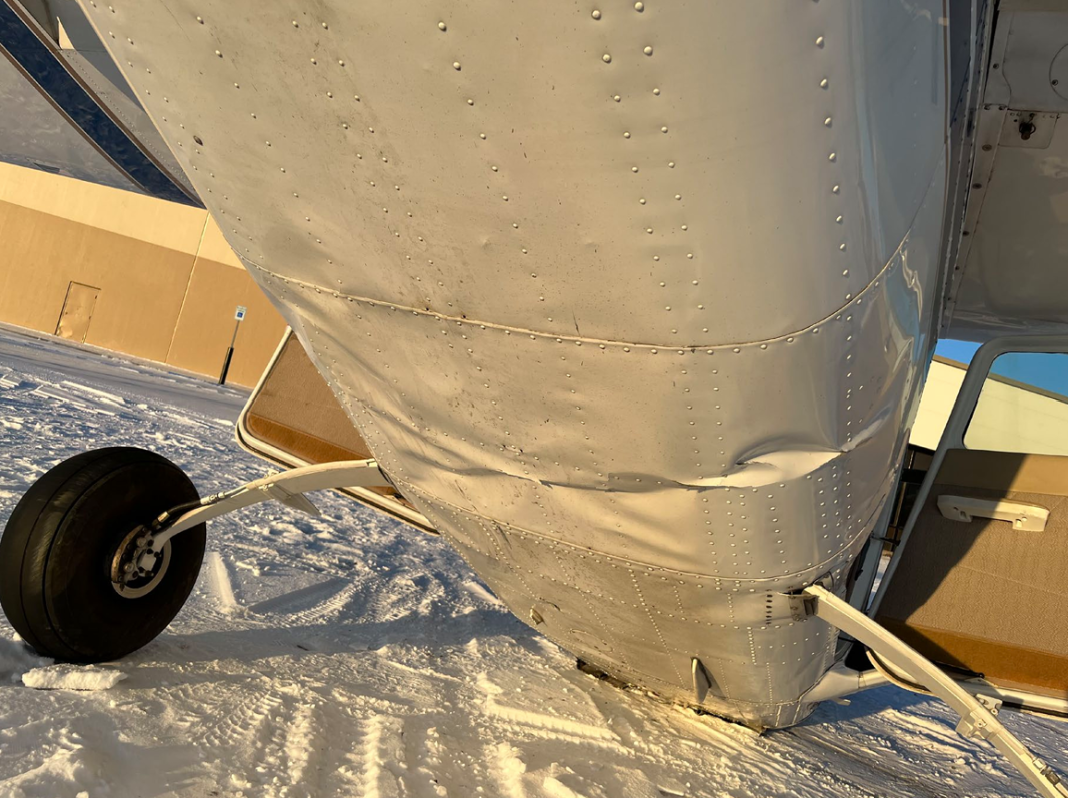
A Cessna 182F, registration N3206U, sustained substantial damage during a forced landing near Anchorage, Alaska, on February 2, 2025, at about 13:54 local time. The engine lost total power while the aircraft was on final approach in the VFR traffic pattern for Merrill Field (MRI). The pilot landed in a vacant parking lot, where the aircraft contacted a curb and the nose gear separated. The fuselage and engine mount were substantially damaged. The pilot and passenger were not injured.
The flight was conducted under 14 CFR Part 91 as a personal flight. The pilot and passenger were completing a 2 hour and 50 minute flight intended to break in two newly installed cylinders that had been installed in the previous November. The departure point and destination were both Anchorage, Alaska, and the approach was conducted in day visual meteorological conditions.
During the flight, the pilot reported keeping the fuel selector on the Both position for the first two hours. For the remainder of the flight, the pilot moved the selector to the Right position. As the airplane entered the traffic pattern at Merrill Field, the pilot reported moving the fuel selector valve from Right, then back to Both, as part of a before-landing checklist.
While established on the downwind leg, the pilot reported that the engine began to run rough and the exhaust gas temperature (EGT) began to rise. The pilot applied carburetor heat, and the EGT returned to normal. Shortly after turning onto final approach, the engine lost total power. The pilot reported attempting to restore power by cycling the magnetos and carburetor heat, but the engine did not restart.
With power not restored, the pilot conducted a forced landing to a vacant parking lot. After touchdown, the airplane contacted a curb, and the nose landing gear separated from the aircraft. The separation resulted in substantial damage to the fuselage and engine mount. The pilot reported moving the fuel selector valve to Off after the accident sequence.
Fuel quantity information collected after the landing indicated a low-fuel condition. The pilot reported visually inspecting fuel quantity before departure but not verifying the amount of fuel in the wing tanks using the aircraft’s dip stick fuel gauge. The pilot stated the airplane was last fueled on December 17, 2024, when 34.3 gallons were added; the total amount of fuel on board before takeoff could not be confirmed.
At the accident site, fuel quantity in each tank was measured using a dip stick fuel gauge calibrated for the airplane. The right wing tank was empty and the left wing tank contained about 6 gallons of fuel. Cockpit fuel gauge indications were also checked at the site. The left fuel gauge indicated empty, and the right fuel gauge indicated just under 1/4 of a tank.
Postaccident examination found the fuel selector valve functioned normally in all selectable positions. A small amount of uncontaminated fuel was recovered from the gascolator when drained. After the fuel valve was moved to Both, additional fuel was drained from the gascolator. Fuel was added to the forward fuel lines in each fuel tank and fuel was drained from the fuel line to the carburetor. Continuity was confirmed between cockpit controls and the engine for the mixture, throttle, carburetor heat, and propeller controls. The carburetor heat line was impact-separated just before the carburetor.
Examination of the engine and fuel system did not reveal evidence of any preimpact failures or malfunctions that would have precluded normal operation. Engine monitor data from an Electronics International MUX-8A device showed a normal takeoff and cruise. During the last minute of the flight, recorded data indicated the EGT increased slightly and then began to drop, along with cylinder head temperature (CHT), which was consistent with fuel starvation followed by a total loss of engine power.
Maintenance and operating documentation reviewed for the airplane indicated that original bladder fuel tanks had been replaced with fiberglass fuel tanks, with a total capacity of 62 gallons and 57 gallons usable. The report stated that fuel consumption at 2,350 rpm with the mixture leaned would have been between 13.4 and 14.0 gallons per hour. The pilot reported leaving the mixture full rich during the flight, which would result in a higher fuel burn rate; therefore, the actual fuel burn for the flight could not be determined.
Findings and probable cause (as stated): “The pilot’s inadequate fuel planning, which resulted in fuel starvation and a total loss of engine power.” Findings listed were: “Use of equip/system – Pilot,” “Fuel – Fluid management,” “Fuel planning – Pilot,” and “Fuel – Fluid level.” The report analysis also stated that the pilot did not lean the mixture during the flight, which likely led to a higher-than-calculated fuel burn rate, and that due to the low fuel state, when the pilot conducted the right turn the fuel tank likely became unported, resulting in a total loss of engine power due to fuel starvation.


