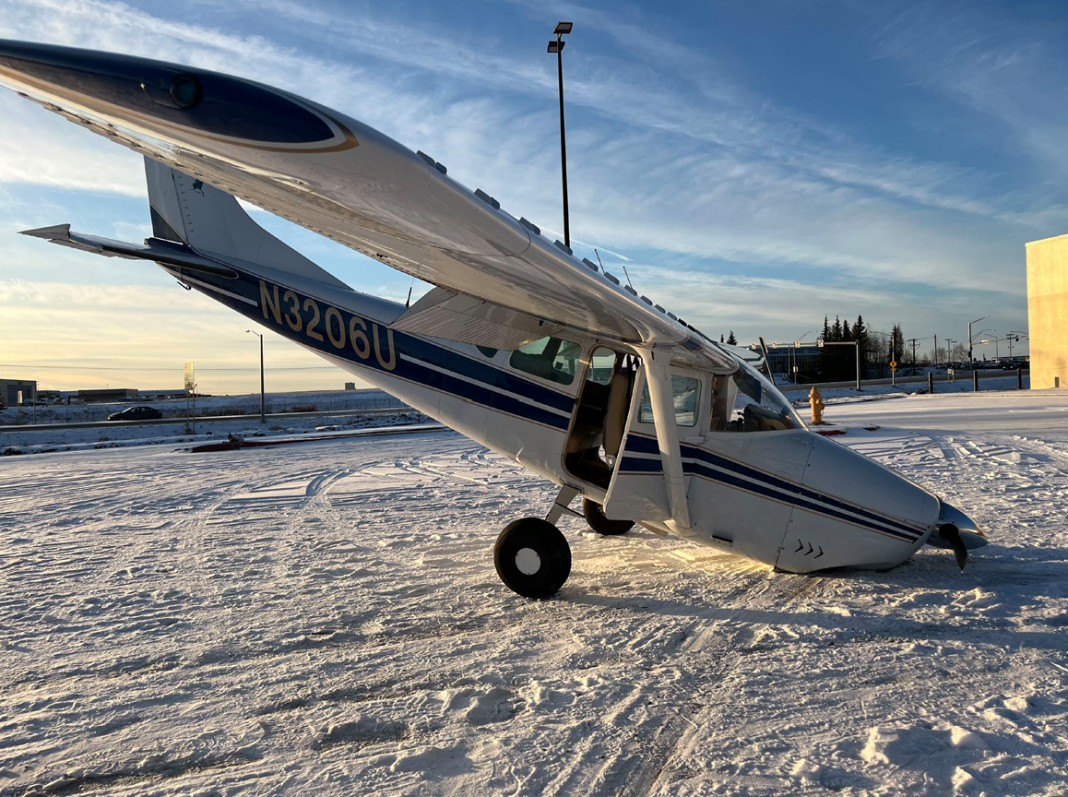
A Cessna 172A, registration N7274T, was substantially damaged during a forced landing on a frozen river near Fairbanks, Alaska, on March 16, 2025, at about 1415 local time. The airplane landed south of Fairbanks International Airport (FAI) after a partial loss of engine power during initial climb. One occupant reported minor injuries, and the other occupant was uninjured. Damage was described as substantial, with wing damage reported after the airplane nosed over during landing.
The flight was conducted under Title 14 Code of Federal Regulations Part 91 as a personal flight. The purpose of the flight was a familiarization flight with a pilot-rated passenger who was a prospective buyer of the airplane.
According to the pilot’s account, an abnormal indication occurred during the pre-takeoff engine run-up. The pilot reported that engine speed did not decrease when the carburetor heat control was pulled. After shutting down the engine, the pilot had the other occupant actuate the carburetor heat push/pull control several times while the pilot observed and felt movement at the airbox mechanism that appeared normal. The pilot then elected to continue the flight.
The airplane departed from FAI at about 1400 local time. Weather at the time was reported as visual meteorological conditions. The observation near the accident site included wind from 160 degrees at 4 knots, visibility of 10 miles, few clouds at 4,000 ft AGL, and a broken ceiling at 10,000 ft AGL. Temperature was -12°C with a dew point of -18°C. The flight operated in Class D airspace and the flight plan section indicated no flight plan was filed, with traffic advisory and VFR flight following noted.
During initial climb, the pilot pulled the carburetor heat control again to recheck system operation. The pilot reported an immediate large decrease in engine speed after pulling the control. The pilot left carburetor heat on, expecting engine power to return if the condition was related to icing. Engine power was not restored, and the pilot turned back toward the airport.
The engine continued to run at low power, but the airplane was unable to maintain altitude. The pilot elected to land on a frozen river south of the airport. During the landing sequence, the airplane nosed over. The resulting damage was reported as substantial, including damage to the wings. No post-impact fire or explosion was reported.
Postaccident examination of the engine and carburetor heat system found that the carburetor heat control cable did not provide the required travel to properly engage the carburetor heat control mechanism in either the fully open or fully closed position. Investigators noted the carburetor heat control was difficult to operate from the cockpit and required excessive force to move the mechanism in either direction. A visible kink was observed in the cable where it attached to the carburetor heat control mechanism.
The examination also found that the clamp attaching the carburetor heat control cable sheath to the carburetor airbox appeared to be installed in the wrong position, about 180 degrees from the position indicated in the Cessna 172 & 175 parts catalog (1956–1962). The cable length was described as excessive, and the configuration meant the carburetor heat was always partially on and could not be changed when actuated by the cockpit control knob. The excessive cable length was attributed in the findings to an inadvertent repositioning of the clamp during a previous engine removal and reinstall that occurred about three and a half years before the accident flight.
Maintenance records reviewed for the airplane indicated no flight hours had been logged since 2021. The pilot reported having flown about 35 hours since the engine had been removed, disassembled, and reinstalled just over three years before the accident; however, the airframe and engine logbooks did not show hours accrued since that engine reinstallation. The engine removal and reinstallation in November 2021 was noted as having been performed after the engine ran without oil.
Environmental conditions were evaluated for carburetor icing potential. A review referenced the FAA carburetor icing probability chart and stated that the conditions at the time of the accident were not conducive to the accumulation of carburetor ice. The final report stated that the excessive length and incorrect positioning of the carburetor heat control cable likely prevented proper operation of the carburetor heat, resulting in partial application of carburetor heat and partial loss of engine power during climb out.
Findings and probable cause (as stated): “The pilot’s decision to initiate the flight despite identifying a malfunction in the carburetor heat system during the pre-takeoff engine run-up, which led to a partial loss of engine power during climb out. Contributing to the accident was maintenance personnel’s improper rigging of the carburetor heat control cable.” Findings listed were: “Decision making/judgment – Pilot,” “Identification/recognition – Maintenance personnel,” and “Fuel control/carburetor – Incorrect service/maintenance.”
Pilot Perspective: When a run-up check shows abnormal carburetor heat response, what is your operational threshold for stopping the flight versus repositioning for maintenance?
We welcome operational perspectives from readers.